Sunday, February 1, 2026

Fourth Sunday in Ordinary Time, cycle A


Matthew 5:1-12

Someone sent me something on Facebook. The title was “What heaven really is, and why many people would not like it”. We imagine heaven to be a state of being in which all our desires are satisfied, and we live in complete happiness for all eternity. That’s probably true, but there are conditions, and some of us may not like them. That’s ok, because you don’t have to go to heaven. There are alternatives.

The author makes the following points:

First of all, heaven is not just about beauty, joy, peace, and so forth. At the core is union with God himself -- the awesome holy presence of God in myself. Second, heaven is the palace where God’s will is everything - nothing exists outside of His will. No pride, no stubbornness, no sin, no complaining; heaven is total surrender. Third heaven is pure holiness; holiness is not just avoiding sin, but it is becoming like God. Fourth, heaven is where nothing, but love remains -- not comfort, not gossip, grudges, revenge, selfishness. Fifth, heaven is eternal worship. Some of us start looking at our watches during the sermon. Heaven is unending praise, thanksgiving, adoration. If your prayer feels empty now, think of what it will feel like in heaven.

Many people like the idea of heaven, but few want to be transformed into someone suitable for heaven. Maybe hell is not fire and demons, but full of people who reject what heaven is -- people who want freedom without obedience, pleasure without holiness, God’s gifts without God Himself. Becoming holy on hearth is heaven’s training ground.

And that brings us to the beatitudes, the eight statements we’ve just heard in the gospel, and the ninth which warns us of the consequences of living that way.

Did Jesus just think of several random things and preach them? He starts with “Blessed are the poor in spirit, for theirs is the kingdom of heaven”. That’s the introduction. The kingdom of heaven belongs to people who have emptied themselves out, who live to do the will of God, who turn their lives over to God.

When you read the next seven statements, they describe what it means to be pure of heart. It’s being someone who mourns. I never quite understood that, but I think it means someone who is sensitive to what is wrong with the world, and is moved to do something about it. It’s being meek. Not being walked on, but recognizing that other people have as much claim on the necessities of life, physical and spiritual, as you do.. IT’s desiring with all your energy, that true justice will prevail. Justice and righteousness are very similar; justice is about reward and punishment; righteousness is justice that seeks to transform through reward and punishment. It’s God’s justice; it’s why bad things happen to good people. It’s being merciful; it’s avoiding things which lead to sin or cause others to sin. That’s “clean of heart”. it's being a peacemaker. Many people like to stir up conflict; they go around saying, in effect, “let’s you and him fight!” They take pleasure in getting people riled up. Just check the internet. Many people live to make other people angry, to sew division. That will never get you into heaven. Jesus refers to righteousness again, when he tells us that the kingdom of heaven belongs to people who are doing something about righteousness -- remember, justice which transforms - even to the point of being persecuted.

And then Jesus looks at you directly, and promises that if you have decided to take him at his word and seriously try to live these beatitudes, you will probably meet a lot of resistance. You might even get your head chopped off, or burned at stake. It wouldn’t be the first or last time something like that happened to someone who tried with all their heart to follow the beatitude, to do what Jesus proposes. And if you are being persecuted and libeled for living this way, you know you are on the right track, you can look forward to heaven.

Heaven is there for the taking. God wants everyone to get to heaven. Jesus tells us that it takes more than just following the ten commandments; it requires allowing yourself to be transformed into someone who belongs in heaven, who is comfortable there.

That of course is the greatest argument for the existence of purgatory -- it’s the completion of God’s work to make us citizens of heaven. For some of us it won’t be long at all, or be very difficult. For others it might take a long time and a lot of work on God’s part to finish what was begun on earth. For some, they will take one look and say, “I don’t really want heaven, thanks anyway, God.” So use the time you have left in life to be the kind of person who will enjoy heaven.

Saturday, January 24, 2026

Third Sunday in Ordinary Time, cycle A

Matthew 4:12-23

Last Sunday we heard about John the Baptist testifying about who Jesus is. That was in the gospel of John. Now we are back in Matthew, whose gospel will be the main one of cycle A, the first of three annual cycles of readings. The Church hasn’t forgotten about the gospel of John; it’s very prominent in all three cycles during the period of time after Easter. So if you are at a party and there is a lull in conversation, tell them that a person who attends mass on all the Sundays and holydays for three years would hear 89.8% of the four gospels. At least that's what the internet told me.

In today’s gospel, Matthew wants us to know that Jesus is up there in the area of Capernaum because it fulfills a prophecy from Isaiah, that those northern provinces have been in darkness and now see a great light. With that as a prelude, Matthew describes the calling of four of the apostles. One of the themes of Matthew’s gospel is that Jesus is ushering in the kingdom of heaven. The signs of that are that the blind see, the lame walk, and the poor have the gospel preached to them. As Jesus goes about preaching and proclaiming that the kingdom of heaven is at hand, we are supposed to notice that his presence and his message cause abrupt changes in the two sets of brothers, both of whom drop everything and immediately follow him. Later Matthew will tell us about his own conversion, using the name Levi, the tax collector who drops everything to follow Jesus.

But there is another character in this short gospel passage, a man named Zebedee. I can remember that whenever I would hear this gospel I would feel kind of sorry for Zebedee, watching his two sons leave the family business to follow a wandering preacher. I wonder how Zebedee felt -- angry? Disappointed? Maybe delighted to give up his sons to Jesus. But there must have been sadness.

Zebedee is an unusual name, not only in the bible, where it is used only in reference to the father of James and John, but also in the names that were popular at that time. The apostles, in fact, had common names -- in the writings of the Jews during those times, we find other men with similar names. And Zebedee never caught on as a name to give your child, unlike many Old Testament and New Testament names.

Zebedee was a real person. His name means “gift of God”. Other parts of the New Testament tell us that his wife was probably one of the later followers of Jesus, and her name was Solome. We find her mentioned in the passion stories as one of the women who met Jesus after his resurrection, and she is referred to as the mother of James and Joses, which was another name for John. She probably became a follower of Jesus because she had first followed her two sons. So she represents another loss for Zebedee.

I think a lot of us, probably most of us, can identify with Zebedee, especially those of us who are parents. As we raise our children, they gradually become their own persons. What we might want for them is often something they don’t want. We might like them to live close so that we can see them more often, but sometimes they move far away. Some of us, like Zebedee, might have built a business we would like to leave to them, and then we discover they don’t want to do that. Maybe we find joy in seeing how our kids turned out, but maybe there is a little sadness because they didn’t follow in our footsteps. When your last child leaves home, there’s a part of you that would like to see a time when the whole family got together again, not just for a day or so but like it used to be. Zebedee must have felt that way as well.

But maybe Zebedee, like his two sons, recognized that Jesus was ushering in the kingdom of heaven, and despite the sadness in his heart, he rejoiced that his two sons were singled out to be apostles, to help spread Jesus’ message, to guide the early church. But at the same time, someone had to run the boat, someone had to fish, because people depended on fishermen. Do any of you parents identify with Zebedee? I know I do.

Sunday, January 18, 2026

Second Sunday of Ordinary Time cycle A

John 1:29-33

The decorations have been taken down and the poinsettias adopted by parishioners.  Christmas trees lacking ornaments lie on their sides by the street, waiting to be transported to a place where they can decompose.  Children are back in school.  We are back in Ordinary Time.  

Ordinary time is potentially a blessing or a curse, depending on a lot of things.  For little kids who have experienced another Christmas, it’s a letdown, and that’s true for some adults as well.  On the other hand, some of us are glad to get back to the routine -- eating normally, doing our jobs. Glad that company will not drop in for a while.  But our reaction to Ordinary Time really is related to our feelings about Christmas, not the actual joys of ordinary time.
The gospel today tells us that John, who has been baptizing crowds, realizes that he did not know Jesus.  That’s hard to believe in the literal sense, because John and Jesus were cousins, probably about six months apart in age.  It’s true that they lived a couple of days journeying on foot, apart from each other.  John’s dad was a priest and had to be in the temple; he probably grew up in Bethany or another little town not far from Jerusalem.  When Mary visited Elizabeth Luke tells us that she went to the hill country.  But certainly John and Jesus must have met at those times when Jewish people gathered in Jerusalem for time like the Passover celebration.  John knew Jesus, just didn’t know who Jesus really was.

I’m one of those people who has a hard time appreciating Ordinary Time -- I don’t know it, I only know it in relation to Christmas and Easter and Lent and Pentecost - all the non-ordinary times.  Ordinary time is just counting the days until the next big feast. When we are baptized we are invited to enter the world of little children -- Because Jesus says that the kingdom of heaven belongs to such as these.   I’ve often pondered those words.  What is it about little children that Jesus admires?  Being the father of six and the grandfather of 20, and now the great grandfather of one, I’ve been around little children for most of my adult life.  Just when I think the last one is leaving childhood, another little child comes into my life.  I wonder if Jesus really knew little children  -  they cry, they keep you up at night, they are stubborn as mules, they need frequent cleaning -- maybe he didn’t mean these traits, maybe he admired them because they do one thing very well that adults don’t do -- they live in the present.

If one gets in a fight with another, a few minutes later they are friends again.  If they are playing in the yard and a grasshopper goes by, they might put down their toys and follow it.  Little children don’t worry about the future -- that’s something they can’t control.  They don’t worry about the past for the same reason.  Adults often worry about the past and future, but can’t control them either.

Maybe that’s something we need to think about in ordinary time.  Christmas celebrates a small part of Jesus’ life. So does Holy Week and Easter.  But Jesus spent three years teaching and healing and driving out demons and forming his apostles to lead his church.  That’s what we should concentrate on in ordinary time.

John the Baptist says in today’s gospel, “I did not know him”.  He says it twice.  If we really want to know Jesus we need to walk along with him through Galilee.  We need to meet the people he met, and listen to the lessons he taught in his stories.  And we can do that by paying attention to ordinary time.  So make a resolution that during this year you will listen carefully to the readings, especially the gospels, of ordinary time so that you can know Jesus better.  Maybe even make it a family affair if you are a parent, or maybe join a group to consider the readings for each Sunday.  And you might find that ordinary time is extraordinary.  

Tuesday, January 13, 2026

Baptism of the Lord 2026

Mathew 3:13-17

Why did Jesus allow himself to be baptized?  That’s a question that people have asked from the beginning of Christianity.  Matthew attempts to give an answer here -- Jesus insists that John baptize him so that “they would fulfill all righteousness”.  Mark and Luke tell the story a little differently and this dialogue is not heard in the other accounts.  What does this mean, to fulfill all righteousness?  

Matthew uses that word about seven times in his gospel.  In all cases, it refers to the act of trying to be in complete accord with the Law of  Moses.  So is being baptized by John something from the law of Moses?  In Jesus' time under the influence of the Pharisees, being washed in water for religious reasons became a practice associated with purification.  In today’s world the Orthodox Jews still practice a ritual like this when someone converts to Judaism, but again it doesn’t mean what it means for Christians to be baptized.  John’s baptism seems to have been somewhere in between the baptism of cleansing to relieve impurity and the baptism that is a sign that you have become a  son or daughter of the Father and an adopted sister or brother of  Jesus.

John’s baptism was “ of repentance"  It doesn’t mean being sorry for one’s sins in the sense that we Catholics bring to confession.  Repentance really means to change one’s approach to the world.  John himself shows what this means in the gospel of Luke, when after calling his followers a brood of vipers, many ask, “What then shall we do?”  John’s answers are surprising -- if you have two coats and your neighbor has none, give him a coat, likewise with food.  IF you collect taxes for a living, collect only what you are owed.  If you are a soldier, don’t use your power to take advantage of people.  In other words, John’s idea of repentance doesn't involve going off into the desert and living on bugs, but just doing what you are supposed to do, and looking after your neighbor.  

The other thing about John’s baptism that made it so popular among the people was that it took place in the Jordan river.  In the days of Joshua, the man who succeeded Moses in leading the  people of Israel, there was a point in their wanderings when they came to the Jordan river and Joshua parted the waters like Moses had done at the red sea, and the people crossed over into the Land of Israel.  Washing in Jordan was symbolic of one’s desire to get back to basics, to recommit to the nation of Israel.  

So Jesus is not being baptized to remove original sin -- that’s a Christian idea.  Jesus is being baptized to commit to a life of righteousness, a life of repentance - it doesn't mean Jesus changes in any way, but like all the other baptized people it’s a symbol of his intention to live righteously for the rest of his life.  And like the other people being baptized Jesus is signifying his desire to be part of the chosen people -- kind of a recommittment.  In other words John recognizes that Jesus is the Messiah and doesn’t need his baptism, but Jesus wants to fulfill what the baptism is all about -- a commitment to live as an ideal Israelite.

After Jesus is baptized, Matthew, Mark and Luke speak of the spirit descending in the form of a dove, and the voice from heaven.  Only Matthew implies that this was only apparent to Jesus.  In any event at his baptism Jesus commits himself to a life of righteousness, a life of living exactly according to God’s true law; and the Father in heaven confirms and accepts this, giving Jesus the Holy Spirit and calling him Son. And this was the point at which Jesus began his earthly mission.  

Jesus’; baptism in the Jordan has nothing to do with original sin, but instead is the moment Jesus commits to his ministry, receives the spirit, and is acknowledged by the Father as his Son.  Jesus was always the Son of God and a human being, not the Son of God living in a human body.  Saint Paul tells us he was like us in all things but sin, so he had to grow,to develop, to be educated, and dare I say it, make mistakes -- because all these things are human.  When we remember that Jesus was as human as you and I, a lot of questions are no longer questions - like why on earth did he pick Judas for an apostle?  Maybe the answer was that he made a mistake.  Why did he knock over the money changer’s tables and whip them with a whip made of cords?  Maybe that day his temper got the better of him.  Jesus never committed a sin, but he was totally human.

In addition to  being in solidarity with his people, the Israelites, Jesus by being baptized is in solidarity with you and iI as well, because our baptism, in addition to being the means by which God removes original sin, is also a baptism of repentance -- when we are baptized we also commit to trying to live a life of holiness; and when we are baptized we also receive the holy Spirit to help us, and if we had ears to hear, we also will hear God telling us “this is my child, in whom I am well pleased."


Sunday, January 4, 2026

Epiphany 2026

Mt 2:1-12

Do you ever wonder what happened to the Magi?  Our early Christian ancestors certainly did.  By the end of the second century a whole mythology had been created from the very small amount of information available in the gospel of Matthew, which we just read.  The Gospel doesn’t say who the visitors were, except that they were magi.  We think that it referred to people of the Persian empire who advised the king -- maybe astrologers.  But some people think the word refers to professional magicians.  Yet somehow early Christians portrayed them as kings.  And you can see why -- they saw a parallel between the coming of the magi and the predictions of Isaiah which we read in the first reading.  Kings will  walk by your shining radiance; camels will bring riches, including gold and frankincense.  You can see how they were referred to as kings.  As for the idea that there were three, that’s another interesting point. Most people think it has to do with the three gifts; if you had twenty magi, you would expect more gifts, I guess.  You could fill a book with jokes about the magi.  Since my birthday is three days before Christmas, I like the one where one of the magi is telling Mary and Joseph that his gift is meant to be both a birthday and Christmas present.  

The early Christians gave the three magi names --  eventually the names Caspar, Melchior and Balthazar became accepted.  Caspar means “keeper of the treasure”..  Melchior means “king of light”.  Balthazar means “protector of the ruler”. They are all derived from the Persian language.  In the sixth century someone wrote a biography of the three magi, declaring them to be royalty -- Caspar was young and from Europe; Melchior was old and from Asia.  Balthazar was black and from Africa.  Our three figures reflect this tradition.  

Finally in the biography the three magi returned to their lands, preached about what they had seen and laid the groundwork for the later preaching of the apostles; and all three were martyred.  In some of the ancient Christian churches like the Armenian church or Coptic church their feast is celebrated.  

And of course our ancestors found significance in the gifts.  Gold was because Jesus is the heir of David's throne, and kings should have gold.  Frankincense is used by priests in worship ceremonies, and Jesus is the ultimate priest.  And myrrh is used in embalming -- a reference to the death that Jesus will ultimately undergo.  Isaiah didn’t predict myrrh, that was Matthew’s contribution.  

And I could go on.  There are astronomers who have advanced theories about the star that the magi followed -- maybe a comet, maybe two or three planets in alignment.  Some have supported their idea by calculating where the likely culprits were in the sky back in the time of Christ’s birth.  

But while all of this is interesting, it reminds me of the comment made about a person who had an opinion about everything -- “He knows a lot of things that just aren’t true.”  

But we can take something away from this story of magi from the east.  Herod’s reaction to the news was to try to find the child and kill him  --- and he did kill the baby boys of Bethlehem -- because Herod wanted no rivals, no one who might displace him.  Herod had executed two of his sons, and he killed a third son who was in line for the throne only seven days before he himself died.  Herod was paranoid that someone might take his place as long as he was alive he would go to extremes to stay on his throne.  The wise men, on the other hand, having traveled all those miles following a star, bearing gifts, finally reaching their goal, where they were permitted to look upon a baby, the child of a poor couple living in a one room shack.  They rejoiced exceedingly because God had revealed to them who this child was; and then they went off into obscurity.

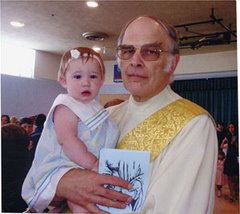
And that is our challenge.  My six-month-old great granddaughter has not yet learned that other people have feelings and needs; she is concerned only about herself.  That’s as it should be.  As she grows she will learn that other people are also concerned about themselves.  And as life goes on she may marry and have children of her own, in which case she will have to be more concerned about others than herself.  And someday, as will be true of all of us, it will be time to gracefully retire from being the center of our lives to allowing the newborn king to be the center of our world.  Will we be like the magi and withdraw from the spotlight in favor of the God-child who has taken on our humanity?  Or will we refuse to give way so that he can be the center of our lives, our world, as Herod refused?  On this feast of the Epiphany, how do we respond to the one who wants to be the center of our life? 

Thursday, December 25, 2025

Christmas 2025

In the creed we always refer to the fact that Jesus, the Son of God, became Man.  And that’s what we are celebrating today.  We refer to this mystery as the “incarnation”, which is latin for “taking on flesh”.  And of course for us Christians that’s the key moment at which our salvation began.  Jesus, the son of God, took on flesh, was born, grew up, preached and worked miracles, suffered and died, and rose again from the dead to return to the heaven from which he came.  But why?  Why did God choose this way to save us?

He didn’t have to.  There was no obligation of God’s part to save us.  But also, he didn’t have to do it this way.  God could have saved us in any number of ways, most less painful and maybe more effective than the way he chose.  What if the incarnation had never happened?

Some of us remember the story of Robinson Crusoe.  There is a scene after the shipwreck when Crusoe finds that many things have been washed up on the beach.  Somehow they all contribute to his ability to survive on the desert island.  Why did these things wash up and many other things didn’t?  In the story this fact just moves the plot along, but it might lead us to the question, why me?  Why did God call me out of nothingness, and not someone else? In a sense each of us has been saved from a wreck.  We don’t have to be, and we don’t have to be what we are.  God’s dealing with us is generous beyond imagining.  Whatever else happens in our lives -- pain, old age, suffering; but joy, loving relationships, children, good food --whatever happens beats not existing at all.  So why did God make you, make me?  One theologian said that the reason was that God thought we might like it; he loved us before we began in our mother’s womb.

Not to digress, but think about the miracle of Cana.  Jesus took water and made it into wine.  Pretty spectacular, right?  But put it against the background of how ordinary wine is made.  Water is taken up by the grape plant and using energy from the sun, and the labor of human beings, it becomes wine.  Jesus, being God, was not doing something unnatural, but something that reflected  the essence of a natural process.  

You may know someone who has had amazing spiritual experiences; I do.  I’ve heard of people who have spoken in tongues, been slain in the spirit, witnessed the expulsion of demons.  You may have heard of someone who was almost miraculously converted; some overwhelming experience changed a life forever.  I’ve known people like that as well, people who almost overnight went from indifference to an overwhelming desire to be a saint.  But just between you and me, I’ve been an average Catholic all my life, never doubting that I was in the right faith, always aware that I do not live up to the standards of the saints.  No sudden conversion, no miraculous happenings.

The incarnation is something like the miracle of Cana.  It’s not a one-off spectacular miracle; it’s a teaching for each of us from God.  God gives his Son, gives himself, really, as a total gift to us because he thinks we might like it.  He shows us his plan through the life of Jesus -- who lives our life, who is like us in everything but sin; who dies, and who is rescued from death and seated in heaven --that’s the gift God offers to us.  And we’ve done nothing for the gift of existing, and nothing for the gift of salvation.  As scripture tells us every good and perfect gift comes from God.  

We live our lives as though we are the center of the universe.  That’s just a fact, not good, not bad.  What do we do in response to God’s gift?  All we can do is give him our hearts.  That’s what love is all about.  Giving God our heart means that we try to put him in the center, which means we try to make room there so God can occupy it.  And you and I can do this no matter what we might have experienced or failed to experience, because incarnation happened and it happens even now as God enters our lives and we are born again, and he gradually or suddenly takes on our flesh, our body, our soul.  

The only thing that is ours, the only thing we can bring to God, is our sin, our false self.  And that’s all he wants.  And we go to him and say “lord, I feel bad about myself, but I’m yours.  Lord, I’m not proud of what I did, but I’m yours.  Lord, I’m sorry for failing you again, but I’m yours.”  And the incarnation reminds us that God has given us the greatest gift he can give -- himself.  And all he wants from us, no matter how sinful, how imperfect, how damaged we may be, is our heart, the center where we live.  He says "move aside, and let me be the center of your universe.  That’s why I called you into being.  That’s why I gave you my whole self.  All I want is your heart.  .

As you leave Church today, pause in front of the manger, look at the baby, and say, “Lord, I’m far from the gift I wish I could give you, but I’m yours; take my heart.”    

Sunday, December 21, 2025

Fourth Sunday of Advent, cycle A

Matthew 1:18-24

If you read the old testament, or are a student of history, the overwhelming picture you get of marriage is that there is a hierarchy -- the man is the center, the woman is concerned to please the man, and the children are expected to honor the mother but even more, to submit themselves to the father’s will.  Male children were expected to follow the father’s trade, or take over the family farm.  Female children were often pawns in the father’s efforts to better himself; arranged marriages benefited the father.   One of the things about Joseph is that he introduces a new way to be a father; he is not the dominating lord of the family,  but is the servant leader instead.

  In the days of Joseph and Mary, when a young woman reached the age of 15 or so, her father would seek a husband for her.  A decent father would be thinking about his daughter’s welfare, but also about what a young man could bring to the family.  And in truth the young woman had very little to say about who her father chose for her.  The Jews were more enlightened than the surrounding societies; Jewish girls could say “no” to an arranged marriage, but it wasn’t a good idea if you wanted to stay in your dad’s good graces.

Once your future husband was selected, there was an elaborate ceremony of betrothal.  And after this, the young woman was considered married, although she still lived with her parents and had no relations with her husband.  That had to wait about a year or so, when the husband would have built a home and established himself in a trade.  When this happened he would notify his bride that he was coming to pick her up and move into her new home, and a great party would be held.  Jesus describes this in the parable of the wise and foolish virgins. 

Joseph and Mary were betrothed but had not lived together.  And when Mary is found to be with child, Joseph decides to divorce her quietly.  Can you imagine his heartbreak?  Saint Augustine said that Joseph decided to divorce Mary because as a good Jew he would offend God by taking an adulterous woman as a wife.  Joseph loved Mary, but loved God more.  Saint Jerome says that Joseph learned from Mary that her pregnancy was an act of God; his impulse was  to get out of the way -- much as he loved Mary, if God wanted her, he did not want to interfere.  Joseph was willing to give up Mary because he loved God more.  

And something new happened.  Joseph took Mary to be his wife because he was told to do so by an angel.  And we can almost feel the relationship that Matthew describes.  Joseph takes Mary into his home despite the stares and snide remarks of the townspeople - either Joe could not control himself, or Joe is marrying a defiled woman.  Joseph gets another dream, and immediately takes his new family to Egypt for a couple of years.  When they return because of still another dream, Joseph settles down to a life of manual labor, taking care of his wife and foster son, fading into the background until his death, sometime before Jesus goes out on his public ministry, 

Joseph is a descendant of King David.  He is told to give Jesus his name, linking Jesus to the lineage of David.  Other than that, Joseph never sees his son perform a miracle (the first miracle, according to scripture, was at the wedding feast of Cana).  He never hears his son preach to the multitudes.  As Joseph takes care of his family, teaches his son his trade, practices his Jewish religion faithfully, he is given no glimpse of what is to come.  His faithfulness and devotion are there, however, as they were before he received the first command of God in a dream.  

And that’s interesting.  I’ve had dreams.  You also.  But have you ever done something because of a dream?  We see in the Old Testament that God sometimes communicated with people through dreams.  The other Joseph, the one who became the right hand man of the ruler of Egypt; Samuel the Prophet, and a few others.  But in the New Testament Joseph is the only one God speaks to in dreams.  And I wonder if Joseph was like you and I and wondered if the dream was really from God.  No flashing lights, miracles, explosions -- just having a dream and deciding it was from God and doing what you were told.  

.  If there is any patron of an ordinary blessed life, Joseph is the patron.  A man who spent his life trying to be righteous, trying always to put God first, and ready always to instantly obey when called upon by God,  even to giving up his bride, even to taking his wife and son to live in a foreign country, even to get up every morning and do the same thing he did yesterday and would do tomorrow.  Joseph, the patron saint of an ordinary life.