Sunday, July 30, 2017

Seventeenth Sunday in Ordinary Time, cycle A

Matthew 13:44-42
Does this gospel confuse you? Or do you just nod your head and agree with what Jesus is saying? It seems as though the people who were listening had no problem. Jesus said, “Do you understand?” and they answered, yes. And then Jesus makes the most confusing statement of all: “Then every scribe who has been instructed in the kingdom of heaven is like the head of a household who brings forth from his storeroom both the new and the old.”
So lets start with that scribe. When we hear about scribes in the gospels, we kind of rank them with Pharisees, not very good people. But actually the role of the scribe was very important. They had three duties: first, to learn the law. That meant memorization and studying what other authorities had said about it. This tradition continues among Jews, who have an enormous collection of literature commenting on every word of what we call the Old Testament. The second duty was to teach the law. Scribes were expected to have disciples, and were to diligently hand on what they knew. And the third was to “make a fence” around the law, which was to dictate how the law was to be obeyed. That's why many Jews use separate dishes for dairy products and meat. There is a statement in Leviticus that you are not to boil a kid in it's mother's milk.
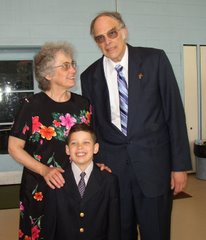
So Jesus is in a sense affirming the duty of someone learned in the law to continue handing on what he or she has learned. It is an admonition to us, especially those of us who are parents and grandparents. Joan and I take trips with our grandchildren and they all know that they are going to have fun spending our money, but also that they will accompany us to daily mass and recite the rosary with us every day we are away. Even knowing that, though, they still seem to want to go with us.
We Christians believe the Bible is God's word. We also have a lot of commentary on the Bible, but it is different in that we read the Bible through the lens of Jesus Christ. He after all is the Word, the Last Word God speaks to us. And because we read the bible through Jesus Christ, we see that there is a trajectory, beginning with the very beginning of time, and culminating in God breaking in to the world he created, so that we can become one with him.
So that's the old. That's the part that every Christian can access; and even though there are thousands of Christian denominations, most of us Christians agree on most of what we believe.
But then there is the new. And Jesus has just finished giving us several images of the kingdom of God. It's like seed scattered around; it's like a mustard seed, or yeast, it's like wheat and weeds growing together, and today, it's like a treasure in a field and a pearl of great price and a net that catches fish indiscriminately, which will be sorted out later into good and bad.
And maybe that's what the new is all about. The parables of the kingdom of heaven do hang together. The sewer who throws the seed everywhere, even onto places it won't grow; the tiny mustard seed that holds within itself the becoming of a large bush; the bit of yeast that causes a very large amount of bread to rise; and the guarantee that, even though weeds try to choke it off, the kingdom will triumph in the end. And today, perhaps, it comes closer to home.
Jesus speaks about a guy who finds a treasure in a field, and a merchant who finds a pearl of great price. And they both sell all they have to get them. They are single-minded in their pursuit; they both, in a way, have defined their lives by the treasure they have been seeking.
We all have a self-image. We carry around a mental picture of who we are. It's not very accurate. We can tell it isn't because when someone treats us in a way that contrasts with our self-image, we feel hurt, disrespected, or at least uneasy. I once suggested to a young scientist I worked with that he should focus on one or two projects rather than the many he was pursuing. I know I injured his self image because he didn't talk to me for about a week.
But if we really want to know who we are, we need to simply look at what we do with our time and money. Because that shows us what we really love. If I think I'm a great parent but I use my spare time to get away from the kids, maybe I should rethink my self image. If I think I am generous but never contribute time or money to a worthy cause, I may be wrong about myself. But Jesus is saying in these two parables that if you single-mindedly pursue the kingdom of heaven, you can't go wrong. And he said it more plainly elsewhere, when he said, “First seek the kingdom of heaven and all else will be given to you.” The man in the field and the pearl merchant were willing to give up everything for what they saw as worth even more than all they had. And on an earthly level, they both knew that once they possessed the treasure, they could have everything they had before and much more.
So Jesus is telling us that a scribe instructed in the kingdom of heaven can bring out the old, but also the new – and the new is that we are passionate about the kingdom of heaven; that we align our love, defined by our time and treasure, with the pursuit of the kingdom. The old is what we know; the new is what we do about it. The kingdom of heaven is like a teenager who mows the lawn for his elderly neighbor. The kingdom of heaven is like a bunch of parishioners who work together to feed shut-ins and people who are bereaved. The kingdom of heaven is like the couple who uses their surplus wealth to promote catholic education. The kingdom of heaven is like a man who spends his spare time letting desperate women know that there are alternatives to abortion. You get the idea.
And those fish. They were all swimming around minding their own business; did they have any idea of whether they were good or bad? Probably in some fishy way they all thought that they were good fish. But the ones who made the cut were the ones who in the end met the fisherman's idea of what a fish was for. None of those fish knew what the fisherman wanted. You and I do.

Saturday, July 22, 2017

Sixteenth Sunday in Ordinary Time, cycle A

Matthew 13:24 - 43
When I was young my parents had a vegetable garden in back of our house. It occupied an area about twenty by forty feet. To me it looked enormous. The reason for that was that my mother had decided that a wonderful activity for her children during the summer was to weed the garden. She learned through bitter experience that I was vegetatively challenged. I could tell peas and beans and rhubarb from weeds, but I had trouble with carrots and onions and potatoes. So my sister and I were assigned to our appropriate sections of the garden.
I had uncles who were farmers. They had a never-ending battle with weeds. They would drag a plow between the rows of corn, or churn up the dirt between the bands of planted wheat Anything to destroy the plants that would steal nutrition from the money crop.
I don't think I've ever met anyone who actually likes weeds. And most of us would gladly live in a weed-free world, especially if we like to grow things. And things were no different in Jesus' day.
But Jesus tells us about a farmer who clearly doesn't understand the principle. Let the weeds and wheat grow together? Clearly Jesus is not a great one for advice about farming. Or sheepherding. After all, he commended the shepherd who left 99 sheep to go find one. No shepherd would do that. Or how about the master who forgives his servant's debt? What financial wizard would do that?
But Jesus says, let the weeds grow with the wheat; it will all be sorted out at the end.
That's why he tells the two parables about the yeast and the mustard seed. They emphasize that the kingdom of heaven is inevitable; it will happen; there's nothing we can do to stop it, or for that matter, to make it come any sooner. It's already here, growing and gradually taking over, even though it doesn't always seem that way.
What should we take away from the story of the wheat and the weeds? It doesn't mean we should be passive in the face of evil. We should not just let things happen knowing that God will win out in the end. Nor should we decide who is wheat and who is a weed. During the middle ages Christians decided other Christians were weeds, so they slaughtered each other. And even during our so called modern age, we all tend to decide who are weeds – and it's never us. It may be the Muslim lady dressed in a black floor length outfit with a head covering. It may be that guy pushing a shopping cart with all his belongings in it. Maybe it's one of our fellow Catholics who is always out picketing the abortion clinic. Hasn't he got better things to do? I think we all have our weeds.
But maybe we should look at this parable a little differently. One thing we have no trouble with is seeing our good qualities. You have them, I have them. But where we are really blind is seeing our sins. After all, if we thought we were sinners, if we really believed that, we'd change our behavior, wouldn't we? If we knew we were guilty of sin, we'd do everything we could to get rid of our sins. But we don't see our own sinfulness. Jesus said that we should remove the beam from our own eye before we tried to remove the splinter from our neighbor's eye. When you read the gospels, Jesus always has problems with the Pharisees. To the average Jew, the Pharisees were paragons of virtue. If the law said to do something or avoid something, a good Pharisee was on board. They were not like the rest of men; in fact a really good Pharisee had nothing to do with the rest of men, even fellow Jews. Jesus' problem with the Pharisees, and perhaps with you and I, is that they did not recognize that they were sinners in need of redemption. In our age, though, we have lost our sense of sinfulness; our modern teachers tell us that the only sins that matter are when we are racist or sexist or islamophobic or homophobic. The Pharisees were made up of both wheat and weeds, and so are you and I.
In the parable at the time of the harvest the wheat and weeds are separated. The weeds are burned up and the wheat is brought into the master's barn. In the parable, the wheat was wheat from the beginning, and the weeds were weeds from the beginning. There was no hope for the weeds. But in God's reality, it's possible for the weeds to become wheat. If you had known Dorothy Day when she was a young woman – an atheist, living with a man to whom she was not married, having an abortion – you might have thought she was a weed. But probably within the next twenty or thirty years she will be declared a saint.
And that, perhaps, is another lesson. God allows us all the time we need to become wheat. What someone seems to be right now is not the final state of affairs. And given that we are all in this together, a true Christian response to someone who appears to be a weed is to try to nourish the tiny bit of wheat that may be there. We owe it to our brothers and sisters to help them on the path to holiness, not condemn or reject them.
So maybe on this Sunday we should reflect on those three things; do we judge others? Do we pre-judge people by their race or accent or the clothing they wear? Do we recognize and mourn our own sinfulness, or have we convinced ourselves that we are all right and have very little to work on? And do we take seriously the responsibility to help the weeds among us become wheat, with God's grace?
The kingdom of heaven is already here, if we know where to look.

Sunday, July 16, 2017

Fifteenth Sunday in Ordinary Time, cycle A

Matthew 13:1-23
We human beings love stories. Joan and I recently attended a conference. There were six speakers. I can remember the gist of five of the six talks because the speakers wove their points in to stories. The sixth speaker was clear, logical, organized – and about half-way through I realized that I wasn't listening. He was laying out a logical argument, but not telling stories.
We love stories, but we are also formed by them. When I was growing up I was the oldest in my family, and got good grades in school. I got a lot of praise from my parents and my teachers, and some of my classmates would ask me for help in their studies. The story was, I was the smart one, and every time I got a compliment or a good grade or a request to help with homework, the story I was living was reinforced. By the time I was in the fifth grade, I identified so much with this story. And then I got my first and only failure mark in my entire educational career – I got an F in penmanship. I guess even then I had the makings of being a doctor, but at that moment in time I was totally devastated. After considering dropping out of school and living in the woods, I set about to learn to write legibly. And I can, if I really want to.
Stories form us. My story affected my sisters. My older sister was often compared to me unfavorably by my parents. My younger sister, I believe, thought that since she shared by genes, she could be smart also, and indeed, she became a professor in a university.
God tells a story. That's one of the reasons we should make reading scripture a part of our lives. That's where God's story is written down and elaborated upon. You may not believe everything in scripture actually happened the way it says it happened, or maybe you do. It isn't important. What is important is that God, working through human beings, formed a very rich but very coherent account of his story, the story of God's eternity- long project of loving a universe into existence and working upon it until it is worthy to be taken up into the heart of the Trinity. God's project is summed up in Jesus Christ.
Today, Jesus tells his disciples a little story. It isn't the whole thing, but it's a part. The first thing we notice is that the sewer is incredibly wasteful. No peasant farmer would even throw seed onto a road, or rocky ground, or into thorn bushes. But our sewer casts seed everywhere – as though he had all the seed in the world, as though he would never run out of seed. And the seed is God's story, God's word.
We all live in stories. Some of us hear God's story and want nothing to do with it. It's too much to believe that God loves me, God wants me for his own, God wants to raise me up in the flesh on the last day to spend eternity with him. Either we don't believe it, or if we do, we like our own story better.
And there are those who hear the story and say, maybe it's better than my story, maybe I should try it on for size. But when they do, it's too much trouble; it's a lot easier to just keep going living my own story. Or we try it out, but before we know it we are distracted by all the stuff in our lives, and we wake up when we are old and realize that we've wasted our whole life on a story that doesn't hold a candle to the one God invites us into.
But there are always a few who hear the story God has for us, and put our whole hearts and souls into living that story, into being shaped by that story.
In the days of Jesus, if you threw a handful of seeds into even good soil and really took care of your garden, you might expect a yield of six or seven handfuls, and if you got ten you would consider yourself a rich man. But the seed our sewer throws out can result in an unheard of abundance for those who choose to live in God's story. And we see that all the time. People who decide to form themselves according to God's story, and abandon their own stories, are the ones who produce abundant crops, more than anyone would have expected. Mother Theresa, Mother Angelica, Bishop Fulton Sheen, Father Benedict Groschel, Maximillian Kolbe – the list goes on and on. People who set out to live the story God has for them, who allow themselves to be shaped by Jesus' story, are the ones who are the hope of the world.
The story in the Bible is a love story. It starts with an incredibly generous God who makes a world in which to place human beings – for we are the object of the love story. God does not just put people on earth, he places the first parents in Paradise. But soon they spurn his love. And the rest of the scriptures is an account of God's efforts to win back the love of the creatures that he loves, until finally he does the unthinkable – he becomes one of them, and he lives their life, and he dies their death, and he defeats death and gives them everything they will ever need to live his story – the Church and the Sacraments. And he promises, in his story, that nothing of his will be lost, that those who choose to live his story will be taken up into the New Jerusalem at the end of time and reign with him forever. And he promises that he will do all the heavy lifting; whatever is lacking in me he will make up. And his story is one of abundance – of giving as though he will never run out of gifts, and of harvesting from us more than we could ever give him – because he works in us so that we will be able to give him more than we could ever give by ourselves.

Monday, July 10, 2017

Fourteenth Sunday in Ordinary Time, cycle A

Matthew 11:25-30
There are certain things which we all know are true. A catastrophe can strike. We can develop a severe illness, or Alzheimer's disease, or have a stroke or heart attack or cancer. In a moment our whole future would change and not for the better. We all know that our world is pretty fragile. If North Korea fires a nuclear missile, we might end up at war with China, and our life style would definitely suffer. Our government seems fragile. Even before our current president, people were defying the law of the land and getting away with it. It's happening even more now. When the law breaks down, it won't be long before some other form of power takes its place; and that probably won't be a good thing.
None of us like to think about these things, because we really don't want our lives to be disrupted. And yet, we know these things are true.
Jesus talks about how The Father has revealed things to the little ones that he has hidden from the wise and learned. And I think Jesus is getting at just what I was talking about. Those of us who are wise and learned get that way because we want to control our lives. We want to understand everything, because understanding is the beginning of control. And unfortunately as we learn more and more about how the world works, and as we find that we can to a certain extend control our lives, we begin to think deep in our hearts that we can control everything – even though we know we can't. But maybe a better way of putting it is that we live as though we are in control; we live a lie.
Jesus speaks of little children but was extending that term to the people who followed him. They were mostly poor and lived from day to day. They all lived close to catastrophe and death. Roman soldiers would confiscate their crops leaving them to starve. You never knew when you might get leprosy and get kicked out of your community. If you were a woman there was a pretty good chance you would die in childbirth. And you knew that you had no control over your life, whether you lived or died. And oddly enough, when you lived knowing those things, you lived like a little child; you enjoyed what you could; you valued your friends and relatives over possessions. Since you had very little it wasn't that hard to part with a little so that someone else might get a bite to eat; after all, you knew that someday the shoe would be on the other foot. Those with nothing, even today, seem to find inner peace and inner joy more easily than those with a lot, the wise and learned.
Jesus looks at us like a loving mother looks at her child. She sees her toddler stumble and fall, or try desperately to do something that he can't do. She looks at his frustration and anger, and listens to his cries – such heartfelt cries – over little things that don't really matter. And she holds out her arms to gather her child to herself and comfort him. That's what Jesus promises us – if we hide ourselves in him, if we put our trust in him instead of ourselves, we will finally be at rest. If we are in Jesus,deep nothing can really harm us, and knowing that means that whatever happens, the fact that we have come to Jesus reminds us that deep down nothing can really harm us.
Jesus goes on further to say that his yoke is sweet and his burden light. In parts of the world, they still use cattle to pull plows. Left to their own devices, cattle live kind of random lives. They spend most of their daylight hours grazing, because it takes a lot of vegetable matter to keep a cow going. And if you've ever watched a rodeo, you know that one thing that really irritates cattle is having someone try to ride on your back. So cattle that are trained to pull a plow have to go through a major conversion. They have to submit to wearing a yoke and pulling a plow. But there is a reward; they are given much more nutritious food – grain, corn, and so on – and they are cared for, sheltered, kept well, because for the farmer, he had to purchase the animal and train it. But what about freedom? You might say. I would venture that cows trained to pull plows and cared for in a humane manner are probably not at all concerned about that.
Jesus says we are kind of like those cattle. If, instead of pursuing our own foolish goals – more money, more power, more security, more stuff – all of which eat into our time and instead of making us more free, gradually chip away at the little freedom we thought we had, and we become slaves to our stuff. If on the other hand we accept Jesus' yoke, work for Jesus' goals, carry his burdens, we find that he is doing most of the heavy lifting.
All of us know how fragile life is; how everything we love can disappear in a heart beat. But we live a delusion; we live as though that isn't the case. And living a lie always takes a lot of work. Today Jesus calls us to step into reality and begin living the truth – begin making all our decisions knowing that everything in this life is transient, and in the end can't do anything to bring us what we truly want. If I want inner joy, than I have to turn away from what substitutes for joy in my life right now. If I want to have real security, real permanence, then the only way I can do that is to rest in Jesus, because he has those things. And if I want a life of real meaning, of real consequence, then in some way I have to allow him to lead, to point me in the right direction, knowing that when I am domesticated, life will be a lot better, here and in the next world.

Sunday, July 2, 2017

Thirteenth Sunday in Ordinary Time, cycle A

Matthew 10:37-42
Many years ago when my family was young and we lived in Buffalo, we took a drive one Sunday up to the shore of Lake Ontario. We had four little kids at the time; it was a hot day. Our old car just gave out and there we were, stalled by the side of the road. There was a house nearby and I went over to see if I could make a phone call. In those days they didn't have cell phones. I was invited in and the elderly couple inquired about my family. They told me to bring them to the house. While I was frantically trying to find someone who could help me, the lady of the house gave my children some juice and a cookie or two. I finally reached triple A and they told me that with my level of membership they would tow my car to the nearest repair shop, which was a long way from where we lived. As I was relating all this to my wife, the man of the house overheard me. He said that I should borrow his car and I could bring it back when my car was fixed. I couldn't believe someone would loan a car to a total stranger, but there it was. In any event, they took my car to the local garage, I drove my famly back home in a very nice sedan, and the next day Joan and I drove back to pick up my car and drop off their car. I offered to pay, but they weren't hearing it. The man was a retired judge, and he told me he was good at reading people and he could tell that I could be trusted.
Today's first reading talks about hospitality. Jesus in the gospel reading also talks about this. We have a few other sayings of Jesus, about being worthy of him, and losing our life so we will find it, but I tried to tie all these sayings together in another sermon, which fortunately you won't have to hear. I want to talk a little bit about hospitality. Jesus thought it was important, the author of the first book of Kings did also, and in the book of Genesis, we could read many examples of hospitality, especially the one in which Abraham offers the three strangers a meal and they in turn promise that Sarah will bear a son.
So what is hospitality? Why is it so important for a Christian, or a Jew, or a Muslim – I think every religion humans have practiced prizes hospitality.
Hospitality is not the same thing as charity. With charity, we recognize the need of another person and try to fill it. We give food to the hungry, clothing to the naked. Charity says that I have something, you need it, and I will give it to you. You are the recipient of my generosity. In this particular area, I am your superior. Charity, I have to say, is a really good thing, and there is nothing wrong with us rich people helping out poor people. And hospitality is not something you have to do. Having your boss over for supper might fall into that category. But hospitality is different.
Anyone can show hospitality to anyone else. You don't have to be rich, the recipient doesn't have to be poor. The person being shown hospitality doesn't need what you offer. But there is a certain reciprocity to hospitality. There is the person doing the offering and the person doing the receiving. We can see in the life of Jesus that he not only offered hospitality, as when he fed the five thousand with the loaves and fishes, or when he washed the feet of his disciples, or prepared breakfast for his apostles on the shores of the Sea of Galilee, but Jesus readily accepted hospitality as well. We remember many such occassions – being waited on by Peter's mother in law, taking part in the wedding feast at Cana, having supper with Martha and Mary, or with Simon the Pharisee.
So what is hospitality, then? I think a good definition is that it is the attempt by two or more people to create a mutual space in which both lay down their defenses. We all go through life with our defenses up. We don't like to have our personal space violated. When we sense that such might happen, we all have ways of defending ourselves. We avoid eye contact. We make excuses that we have to be somewhere else. We conspicuously look at our watches. Or we may just smile, say a few words of greeting, and move on. In summary, we treat the other person as an annoyance, a bother, an “it”.
When we exercise hospitality, though, we deliberately attempt to relate on a person to person level. This means giving up time, giving our full attention, setting up a relaxing atmosphere to the extent that we can. That is why hospitality is so often associated with a meal. In that situation, whether we are waiting on or being waited upon, our body language and our actions say, “you are a person worthy of my time and effort, you are a person from who I will accept kindness.” Hospitality makes us more human.
I think that's why we see so many acts of hospitality in the scriptures, and indeed, we see Jesus himself calling us to hospitality. Jesus says, “He who receives you receives me, and the one who sent me.”
Sometimes when we think about our religion it seems to be a list of dos and don'ts, most of which are slightly unpleasant. Of course if they were all fun we wouldn't need a list, would we? But there are many things that our faith calls us to do that are actually sources of joy, and the call to hospitality is one of them. Jesus after all said that he came to bring us joy.
In the first part of today's gospel we hear about ways in which we are not worthy of Jesus – loving parents or children more than him, failing to take up our cross and follow him. But I think Jesus is reminding us that we aren't worthy of him, no one is. But He then tells us that if we work together to create that mutual space in which we exercise hospitality, in which we strive to see the other person as a person, not a thing, even if it is only a small act of kindness, Jesus will be there in our midst, along with his father. And that is indeed a great reward.

Sunday, June 25, 2017

Twelfth Sunday in Ordinary Time, cycle A

Matthew 10:26-33
I had a friend in medical school who was very bright and destined for a great career. In the summer of our fourth year, he joined a group of medical students and a few professors and went to Mount Everest with the intention of climbing the highest mountain on earth. Through a freak accident he slipped while not attached to the safety rope and fell to his death. We, his classmates, couldn't believe it. What terrible luck. What an awful roll of the dice.
One of the mysteries that confront people who believe in God goes something like this: If God is good, why does he let evil happen? And if God is all powerful, why doesn't he stop evil from happening? And if Jesus promised that if we ask anything in his name, it will be given to us, why is it so obvious that this doesn't work?
There are many different answers to this theological problem. One, advanced by the mathematician and philosopher Gottfried Leibniz, is that of all the possible worlds that could exist, this is the best. In other words, God has seen to it that everything is optimal, and if you were to change one thing, other things would change for the worse. This is the best of all possible worlds. And of course the response comes: how do you define “best”? Isn't this sort of a cop-out? Any human being could point out a few little things that could make everything better and if we are considering everything from a cosmic perspective, it is no consolation that there is innocent suffering and tragedy in this particular moment in space and time.
Our Muslim brothers hold that everything that happens is the will of Allah. Most Muslims are like you and I, they don't think too hard about what their religion teaches. But a few who realize the implications of this are the ones who will blow themselves up in a public square; after all, if it happens, it was Allah's will. And if you truly believe this, then whatever you do is Allah's will, even if it means that you end up in hell. There is no wiggle room, there is no freedom at all.
Alfred North Whitehead theorized that God was what he called “dipolar”. In his primordial nature he is unchanging, all powerful, present everywhere, all knowing – all those things we think about when we think about God. But God has a consequent nature as well; he is affected by everything that happens in the universe. Everything that happens is received by God, who saves everything that can be saved. God alone is the sum of everything that could be; and the things that make up the universe as yearning for permanence, for transcendence, which only God can provide. So God and the universe are interdependent, in a way. Professor Whitehead started a movement called “process theology” which still has many adherents. While this is a solution to the problem of why bad things can happen, it goes against the Judeo Christian conception of God as completely independent of the Universe.
But Jesus gives us an insight today. He talks about sparrows, and that not one of them falls to the ground apart from the Father's care. In other words, sparrows fall to the ground. The fact that they do does not deny that God cares. The fact that a sparrow falls is not a moment of bad luck, an unfortunate circumstance, a chance happening. At the same time it isn't something God causes to happen. It is as though God steps back, allows his creatures freedom, and then takes whatever happens and weaves it into his grand plan for the universe he created. Do we have anything to say about this? Not really. God's will will triumph, and we can't do a thing about it. But what we can do is align ourselves with God's will. We have the example of Jesus, who prayed, “Father, if you are willing take this cup from me, but not my will, but your will be done.” We have the example of Mary, our mother and Jesus' mother who said, “Be it done to me according to your word.”
Everything that happens is God's will. But we are not robots, we are not puppets in God's hands. God gives each of us total freedom, so that we an always choose to do his will or to resist it. And if we resist it, in a sense we create our own reality, in which we choose not to be part of God's plan, which ultimately is hell. Saint Theresa of Avila said two things about hell. One was that she had experienced a vision in which she experienced hell. It was not hot, there were no devils poking her with pitchforks. It was a state of having no sensation at all. She could not see, hear, taste, smell or touch; she was aware of being entirely alone – forever. She could not even experience the passage of time. When you think about it, that is worse than any picture of hell you might have imagined. Human beings, even hermits, are social creatures, and we define ourselves in relation to other people. To be deprived of this is devastating, and babies who are not touched and held and spoken to wither away and die.
Saint Theresa also said that she truly believed in hell, that there was such a state of being. She did say that she did not think there was anyone there.
So whatever we do, God's plan goes on. We see this in the Old Testament; whenever the Jewish people abandon God, he rescues them and gets them back on track. The individual people who might have lead the Jews astray may die, but the plan goes on, and it still does.
And the best thing is that God has revealed in Jesus his plan for the universe, his plan for the human race, and his plan for you and I. And as Jesus has shown, and as Mary has shown, those who embrace God's plan, those who choose his will over their own, they are the ones who can expect resurrection and eternal life. There is no chance in God's world, no bad luck or good luck. There is only the unfolding of the plan, and our freedom to be part of it or not. Today let us pray that we will be willing agents of God's plan by listening to His Son.

Monday, June 19, 2017

Corpus Christi, 2017

John 6:51-58
I go down to Baystate and Mercy hospitals now and then to see if I can find any parishioners. In the olden days, you could walk in, go over a list of patients who had been admitted and categorized by denomination, and look down the list for people you might know. Now you can only find them if they have listed their church and their denomination on their admission form. But I'm getting off tra here. What I notice more and more is that as you walk through the halls of the hosptals, everyone is looking at a smartphone. You can see a mother and father with a baby; the parents each are attending to their phones instead of the baby. You can see an elderly woman being pushed by someone who is probably a son, and he is looking at his smartphone. There was a recent article that some people consult their smartphones as often as 150 times a day – that's about every six and one half minutes if they sleep for eight hours. And the article went on to point out that recent studies have shown that smart phone addiction is now the second most common cause of divorce among young married couples.
I think we can all tell why. If you want to deepen a relationship you have to work at it. That's pretty straightforward and we all know that. And if you don't put down the smart phone and actually interact with your beloved you will never grow that relationship.
We Catholics, along with members of the Orthodox churches, believe that God has given his priests the power to take ordinary bread and change it into the Body of Christ; to take ordinary wine and change it into the Blood of Christ; and of course we go on to say that now that Christ is resurrected you can't really separate the body and blood anymore, so that Jesus Christ is fully present, body and blood, soul and divinity, in the Bread and in the wine. And that power is given for reasons we can't begin to fully understand. But part of the reason is that Jesus promised to be with his church always, even to the end of time, and this is one of the ways he keeps his promise. And most of us who come to Mass every week if asked, would probably say that, “Yes, I believe that Jesus is really present in the sacrament of the Eucharist”. And we would probably not give it much more thought.
It's interesting that he chose bread and wine for this sacrament. To the people of Jesus' time, bread was something like a pita. You used it to pick up pieces of the main meal or to dip in broth or gravy. Jesus is saying that if you want the good things the Father has to offer, you need him; he is essential. People didn't bake bread in individual portions, either. The dough was kneaded and stretched and placed over a fire on a flat stone or stuck to the wall of an oven. Indian bread is still made that way. But that meant you had to share the bread and Jesus means that as well. As for wine, in Jesus time everyone knew wine was good for you. If you mixed a little with water, you were less likely to get sick from the water. If you poured it into an open wound, you were less likely to get infected. Remember the Good Samaritan story? But wine also brought joy. People were well aware that wine lowered your inhibitions, aided your conversation, and helped you take your mind off your troubles. Of course you could overdo it, but in moderation the effects were all good. Jesus tells us that he is the source of healing and joy.
Jesus becomes our food and drink for many reasons, the primary one, perhaps, being that he wants to form a relationship with us. He is showing us how far he will go – he will allow us to consume him, he will seek a union deeper than any we can have with another human being; Being God, he becomes food and drink; and being man, his body becomes part of our body, and our bodies become part of his. Some of our Protestant brothers and sisters talk about developing a relationship with Jesus; but for us Catholics that relationship goes far beyond being a friend, or even a lover.
But we suffer from cell-phone-itis. Our living, breathing Lord makes himself available to you and I as food and drink, and we consume him and off we go, immersing ourselves in our day to day concerns until then next encounter.
We Catholics used to have a Eucharistic spirituality. We treated the consecrated bread and wine as we would treat Jesus himself. We did it in ritual, to be sure, but ritual is the beginning. There was a fence between the congregation and the altar, not to keep the people away, but to show that this was holy ground. When the priest consecrated the bread and wine, he would hold his thumbs and index fingers together until after communion, because they had touched the body and blood of Jesus. When communion was distributed the altar servers would hold a golden paten under the priest's hands, so that if the host were accidentally dropped, it would be caught. And we were told never to chew the host, because that was how we ate ordinary food and this was by no means ordinary food.
And we would have benediction, when we would take the Blessed Sacrament from the tabernacle and place it in a monstrance so that people could look at Jesus and commune with Him in a special way. We still do that, by the way, but only a small number of our fellow Catholics take advantage of this special time. And we would have Eucharistic processions in which we would carry our Lord out into the streets of the city, showing the world that we were Eucharistic people.
Now I'm not trying to be nostalgic; I'm not one for saying we should go back to the old ways. But if we believe in the Real Presence, we should express that belief in our actions, and the more we do that, the more we will believe, the more we will come to know Jesus in the breaking of the bread. So today on this feast of Corpus Christi, the feast of the Body and Blood of Christ, put down your spiritual cell phones and turn to the one who has become food and drink to nourish you spiritually, to become one with you, to give you the means to become like him. Begin a conversation with him, if even for a short time; make him your only concern, if even for a few minutes. Speak to him as you would to a friend, if only for a few words of love. Jesus has become present to you in what used to be bread and wine; it is up to you and I to become present to Him.