Fourth Sunday in Easter, cycle A
John 10:11-10
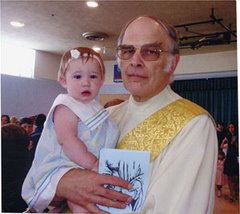
As some of you know, Joan and I have a great-granddaughter. In addition to making us feel really old, she is a delight to hold and talk to, although not much talking can be done with a ten month old. Not too long ago I was holding her and she was going after my glasses and the pen in my pocket and whatever else drew her attention. And I would put my finger on her nose and say “boop!” which amused her to no end. However, after 20 minutes or so, she became restless and started glancing around until she caught the eye of her mother, at which point she started yelling “Mamama” until she was safely nestled in her mother’s arms.
We human beings are restless, never quite satisfied. Henri Nouewen, the author of the book “The Wounded Healer” said that there is no such thing as pure joy. Even in our happiest moments there is a shadow, a fear, a jealousy, a restlessness inside us, no matter how young or old we are. That old New England transcendentalist, Henry Thoreau said that most men lead lives of quiet desperation. Probably it would be safe to say all of us do. We can be distracted for a while. We know what distracts -- drugs, alcohol, gambling; but indeed activities like golfing or playing other sports. We can throw ourselves into hobbies. But we all know these distractions only last for a little while and then we are back to our restless selves. One of the most insidious distractions today is the cell phone. I watched several teenagers leaving the high school a few days ago. None were talking; all were immersed in what their phones were showing them. No one was talking to the guy or girl walking along with them. And cell phones are probably the reason that in our country the average young woman is expected to have 1.6 children in her lifetime -- there won’t be any of us left in 400 years at that rate.
In the gospel of John at the very beginning Jesus turns to two men who are following him and asks, “what are you searching for?” And the whole gospel is an attempt to answer that question. It finally is answered when Jesus asks Mary Magdalene in the garden, “Who are you looking for?” and as she stumbles through her answer, he interrupts her by calling her name, and suddenly her soul is at rest.
Do you ever imagine what heaven is like? I can go back in my memory and see the evolution of the idea of heaven in my own life. Obviously as a little kid it was a place where I could get whatever I wanted and there were no rules to ruin my fun. As a teenager it was a place where all the things wrong with my life would be corrected -- my skin problems, the fact that I was taller than everyone else, the fact that the cute girls didn’t seem to gravitate my way -- I had a long list. In college I learned about the beatific vision, that heaven was when I would behold God in all his infinite majesty and beauty and I would need nothing else to satisfy my soul. It didn't sound like a good time, though -- but I figured Saint Thomas can’t be wrong. And over the years I discover that I don’t think about heaven much anymore. I can’t imagine a way to fill up an infinite amount of time. It’s like someone said, “some people want to live forever but can’t find enough to fill up a Sunday afternoon.” And of course the older I get the more I resonate to those words that describe the next life as eternal rest.
What are we looking for? My great granddaughter has the right idea, and her mother satisfies that inner restlessness for now. Jesus tells us today that he is the gate. IN those days the shepherds would herd their sheep into an enclosure and take turns lying across the entrance. The shepherd who blocked the entrance was called “the gate”. And in the morning each shepherd would call his sheep and they would sort themselves out, and each flock would go with its shepherd in search of grazing ground. My great granddaughter will learn, as she grows older, that all the places she looks, all the people she turns to, eventually will fail to satisfy that emptiness within. And I pray that she, and you and I and everyone here in this assembly will eventually find that voice that will truly fill up the emptiness, the voice of the shepherd, the voice of Jesus, who will call us by name, as he called Mary Magdalene.